In China, the question “What is the fire rating of standard WPC flooring” has no single universal answer. WPC means wood-plastic composite, but its fire performance changes with resin type, wood-fiber content, thickness, backing, surface film, and installation method. A 5-millimeter plank over a foam underlay may behave differently from the same plank fixed to a mineral substrate. The sample matters.
China’s GB 8624 standard classifies construction products by reaction to fire. Flooring products are commonly assessed through ignitability, heat release, flame spread, smoke, and burning droplets. GB/T 11785 uses a radiant heat method for floor coverings. Internationally, ISO 9239-1 and EN 13501-1 provide comparable testing frameworks, while ASTM E648 is widely referenced for critical radiant flux. These are technical benchmarks, not marketing slogans.
A supplier may describe WPC flooring as Bfl-s1 under the European system, yet that result cannot automatically become a Chinese compliance claim. The laboratory report must identify the exact product, thickness, substrate, adhesive, and production batch. It should also show the testing laboratory’s accreditation and report validity. Small details decide the result.
Some manufacturers publish only “fireproof” or “flame-retardant.” That is insufficient evidence. The wording sounds reassuring. It is not a rating.
This article examines Chinese testing practice, common WPC compositions, and the difference between a tested classification and a general product statement. It also considers limitations. Real buildings are less predictable than laboratory specimens, especially around joints, edges, and underlayments. Better documentation supports safer decisions, but no certificate replaces proper installation and project-specific review.
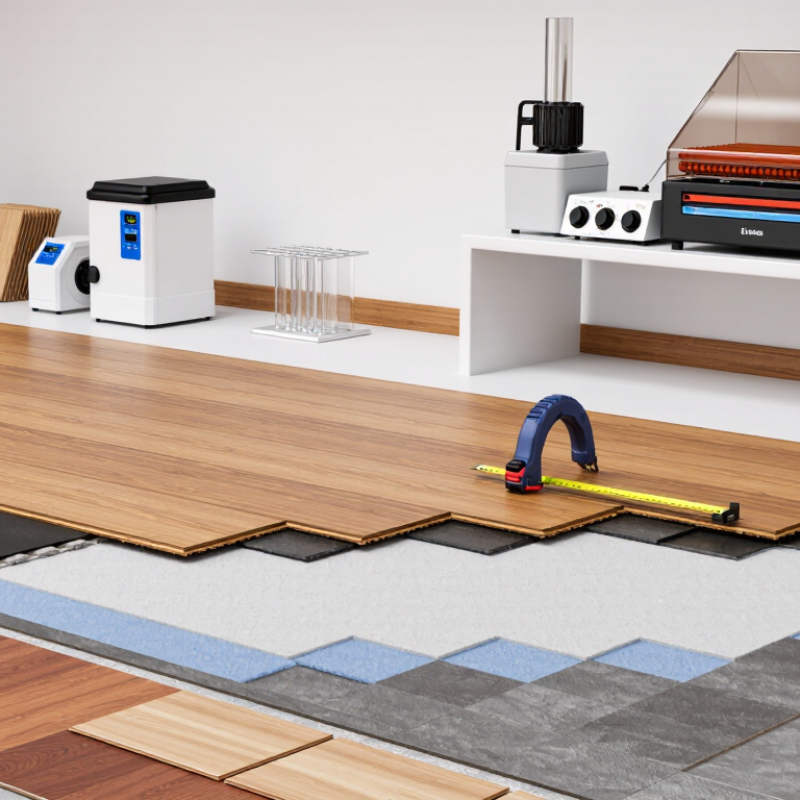
Standard WPC flooring in China does not have one automatic fire rating. Its classification depends on resin content, wood fiber, additives, thickness, surface coating, and installation method. A product described as “standard” may perform differently from another WPC floor.
China commonly uses GB 8624 for the reaction-to-fire classification of building materials. Flooring may be assessed under floor-specific categories, such as Afl, Bfl, Cfl, Dfl, Efl, or Ffl, with smoke levels shown by “s1” or “s2” where applicable. The exact test route can involve flame exposure, heat release, smoke production, or radiant heat. GB/T 8626 and GB/T 11785 may be relevant during testing.
Building projects also need to consider GB 50222, which addresses fire protection for interior decoration. Requirements can change with building use, height, evacuation routes, and installation location. A WPC floor approved for a private room may not meet requirements in a public corridor. This detail is often overlooked.
In practice, buyers should request a current Chinese test report, classification certificate, and product specification. Check whether the report covers the complete flooring assembly, including underlay and adhesive. Some documents test only the plank itself. That creates uncertainty. I have also seen “flame-retardant” wording treated as a fire rating, although the terms are not identical. Final acceptance should come from a qualified testing body or project fire consultant.
| Data Dimension | Typical Information for WPC Flooring in China | Practical Meaning | Relevant Standard or Verification |
|---|---|---|---|
| Whether there is one universal fire rating | The fire performance of WPC flooring depends on the formulation, PVC or PE content, wood-fiber proportion, additives, backing layer, surface coating, thickness, installation system and test specimen. | Confirm the rating from a valid test report for the exact product construction rather than relying only on the term “WPC flooring.” | |
| Common Chinese fire classification reference | GB 8624 classifies the combustion performance of building products and materials. The commonly referenced Chinese levels are A1, A2, B1, B2 and B3. | A1 and A2 represent higher levels of non-combustibility or limited combustibility. B1 means flame-retardant or difficult-to-burn performance, while B2 and B3 indicate progressively greater combustibility. | GB 8624-2012, Classification for Burning Behavior of Building Materials and Products, should be checked for the applicable product category and test method. |
| Typical target for commercial WPC flooring | B1-level performance is a common procurement target for indoor commercial or public-area flooring, but it is not automatically achieved by every standard WPC product. | The product may resist ignition and flame spread better than ordinary combustible flooring, but it can still burn under sufficient heat and may produce smoke. | Require a classification or test report issued for the finished flooring product, including its wear layer, backing and installation configuration where applicable. |
| European-style classification sometimes shown on Chinese test documents | Bfl-s1 or Bfl-s2 may appear when the flooring is evaluated using a floor-specific classification system. “fl” means flooring. | The first part describes reaction to fire, while “s1” and “s2” describe smoke production, with s1 indicating lower smoke production than s2. | These classifications should be linked to the actual test method and report scope. They should not be converted to a Chinese GB level without a qualified technical assessment. |
| Flame spread and heat release | Fire testing can evaluate ignition behavior, flame spread, heat release and the formation of burning droplets or particles. | A product with a satisfactory flame-spread result may still release heat or smoke. Fire rating is therefore a group of performance indicators, not a single visual property. | Check the test items and results stated in the report, including the specimen thickness, surface finish, substrate and conditioning procedure. |
| Smoke production | Smoke performance is reported separately in systems that use smoke subclasses, such as s1, s2 or s3. | Lower smoke production can improve visibility and evacuation conditions during a fire, but it does not mean that the product is smoke-free. | Review the smoke classification and the measured test data; do not infer smoke performance from the B1 designation alone. |
| Burning droplets or particles | Some classification systems separately evaluate whether flaming droplets or particles are produced during testing. | Burning droplets can increase the risk of fire spread to materials below or near the flooring. | Check whether the applicable report includes a droplet or particle classification and whether it applies to the complete flooring assembly. |
| Influence of product structure | Rigid-core WPC, composite-core SPC/WPC, multilayer flooring and products with foam underlay may obtain different results even when their surface appearance is similar. | The core, adhesive, backing and underlayment can materially change ignition, heat release and smoke behavior. | The tested sample should match the supplied product in composition, thickness, surface layer, backing and installation method. |
| Influence of installation | Loose-lay, click-lock and fully bonded installations may have different fire behavior, particularly when an underlayment or adhesive is used. | A report for the flooring panel alone may not represent the performance of the complete installed floor system. | For projects with strict fire-control requirements, request testing or technical evaluation of the complete floor assembly. |
| Use in public or high-occupancy buildings | Fire-performance requirements can be stricter in public buildings, transport facilities, healthcare premises, schools, hotels and other high-occupancy areas. | Project requirements may depend on the building type, room function, escape route, floor location and local approval conditions. | Check the applicable Chinese building fire-protection and interior-decoration requirements, including GB 50222 where relevant, together with local project specifications. |
| What a reliable report should identify | Product name or model, construction, thickness, test standard, laboratory, test date, specimen details, conditioning, test results and classification. | These details establish whether the report is traceable and whether it represents the product being purchased. | Reports should be issued by a competent laboratory and should clearly cover the exact product rather than a materially different sample. |
| Recommended purchasing conclusion | Do not specify “standard WPC flooring” as a fire rating. Specify the required GB classification or project-approved classification and request supporting documentation. | For many commercial applications, buyers commonly request evidence of B1-level performance, but the required level must be confirmed by the project’s fire designer, authority or specification. | Use the current project specification and the latest applicable Chinese standards. Fire classification should be confirmed before installation. |
No. Its rating depends on resin, wood fiber, additives, thickness, coating, and installation.
China commonly uses GB 8624. Floor classifications may include Afl, Bfl, Cfl, Dfl, Efl, or Ffl.
They describe smoke production during testing. Lower smoke can support safer evacuation, but the complete result matters.
Not necessarily. Building use, height, evacuation routes, and installation location may change the required classification.
Request a current Chinese test report, classification certificate, and product specification for the exact model.
Usually not. A 5-millimeter sample may perform differently from an 8-millimeter product.
Yes. Check the plank, underlay, adhesive, joints, and substrate. Testing only the plank creates uncertainty.
No. The wording sounds reassuring, but it does not replace an official classification result.
Adhesive type, floor gaps, backing layers, exposed edges, and the underlying substrate can affect heat and smoke movement.
Inspect joints and exposed edges. Confirm batch details and test methods. A qualified testing body or fire consultant should review acceptance.
What is the fire rating of standard WPC flooring? In China, it depends on the product’s composition, structure, and test results rather than on a single universal rating. WPC flooring is generally classified according to its reaction to fire, including flame spread, heat release, smoke production, and the formation of burning droplets. Fire performance is evaluated through standardized laboratory tests that may examine ignition resistance, combustibility, flame propagation, and smoke behavior under controlled conditions.
Several factors can affect the final rating, such as the type and proportion of wood fiber and polymer, additives, surface coatings, flooring thickness, density, installation method, and joint design. Buyers should verify the fire rating certificate by checking the product name, tested model, applicable standard, test date, laboratory qualifications, and whether the certificate matches the actual flooring supplied. A reliable assessment should be supported by complete test reports rather than unsupported marketing claims.

 KandS Floor